Guide
How to get started, what each screen does, a practice plan for your interview date, and answers to common questions.
- Getting started
- The screens
- Interview stages
- Reading your report
- Answer drilling
- Practice plans
- Video interview limits
- FAQ
Getting started
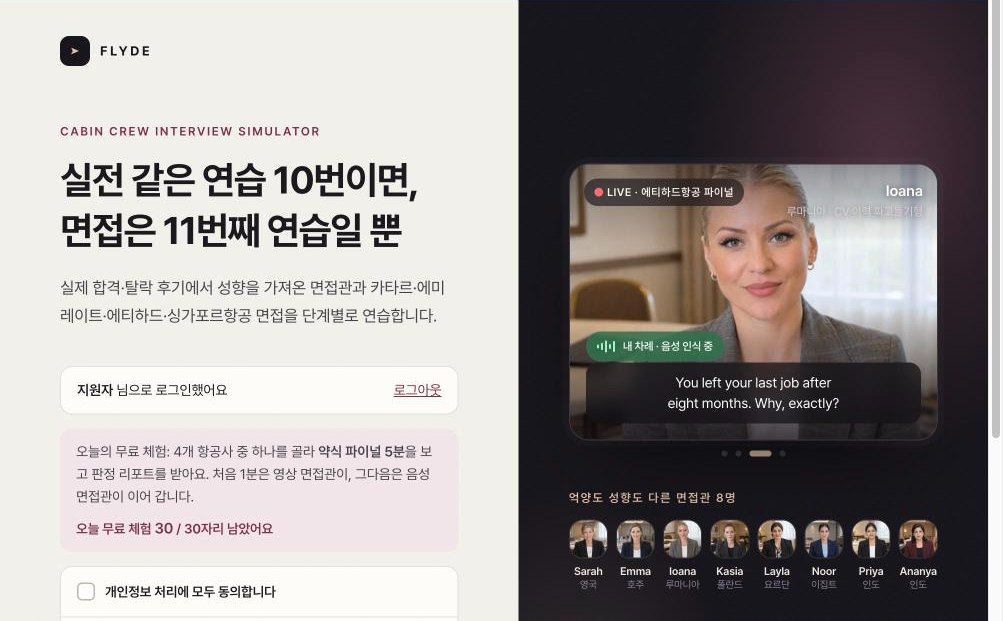
- Open sim.flyde.online in Chrome on a PC or laptop. Speech recognition only works in Chrome.
- Sign in with Continue with Google. Your pass belongs to your account, so you can continue on any computer with the same account.
- Choose an interview, allow camera and microphone, and you start right away. We recommend earphones so background sound doesn't get mixed in.
The screens
Use the tabs at the top to switch between Mock interview and Answer drilling.
A full interview, start to finish
Pick an airline and a stage. The interviewer asks in English, follows up on your answers and sometimes cuts in. You get a verdict report as soon as you finish.
Learn your answers by saying them
Upload your answer script and it's split into one card per question. Four steps, from listening to facing follow-up questions, until you can say each answer without the script.
What you choose before an interview
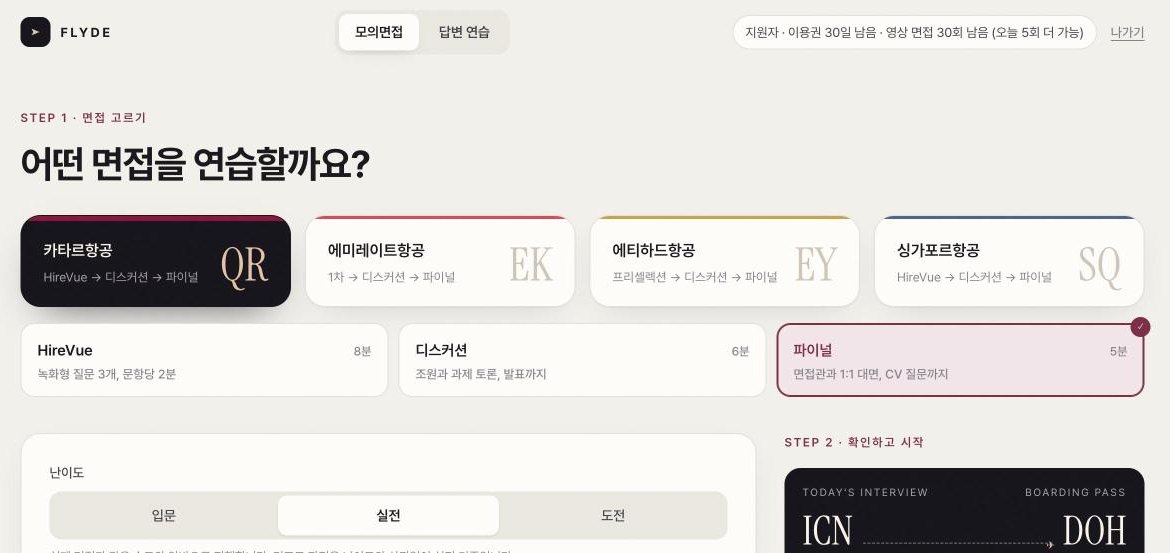
| Airline & stage | Pick one real stage from Qatar Airways, Emirates, Etihad or Singapore Airlines. Each stage shows its expected length. |
|---|---|
| Difficulty | Beginner is slow, simple English with no pressure. Real matches the speed and pressure of a real interview. Challenge pushes harder than the real thing. |
| Accent | Native (UK, Australia), Eastern European (Romania, Poland), Arab (Jordan, Egypt), Indian, or random. You can't choose the accent on the day, so switch to random once you're comfortable. |
| Interviewer type | Interviewer styles taken from real candidate reviews: friendly, high pressure, interrupts often, and more. |
| Group size | For group discussion: how many virtual candidates join you (3 or 4). |
| CV (optional) | Upload your English CV as a PDF or image and the interviewer asks about it. It's only used to write questions and is not stored. |
During the interview
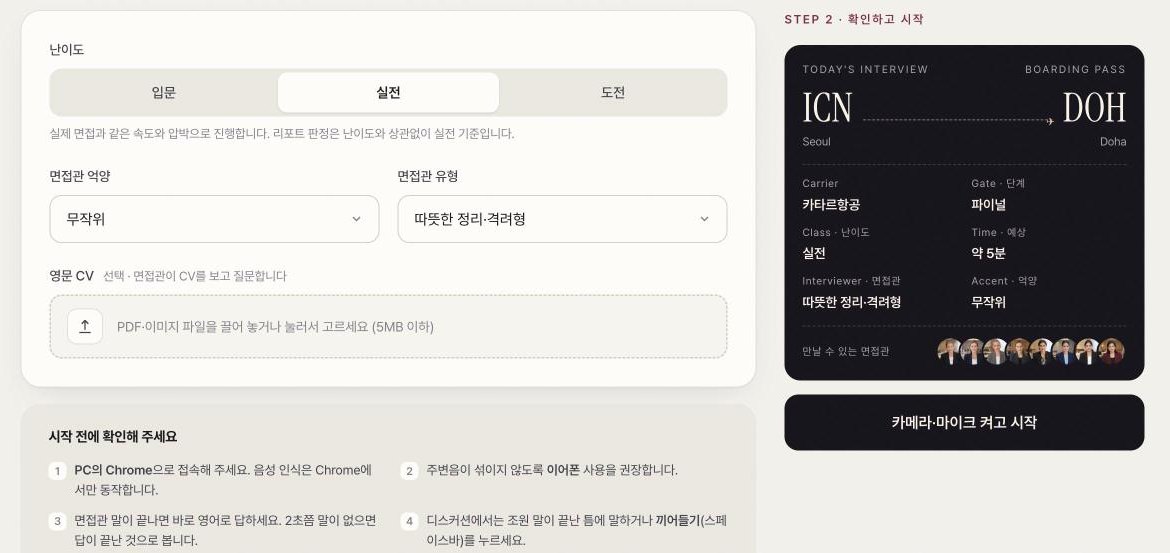
- Answer in English as soon as the interviewer finishes. About 2 seconds of silence ends your answer.
- In group discussion, speak in a gap after someone finishes, or press the space bar to cut in.
- Interviewers and group members are virtual characters whose styles come from real candidate reviews.
Interview stages
| Airline | Stage | What happens | Length |
|---|---|---|---|
| Qatar Airways | HireVue | 3 recorded questions, 2 minutes each | ~8 min |
| Group discussion | Group task and presentation | ~6 min | |
| Final | One-to-one with a recruiter, including CV questions | ~5 min | |
| Emirates | Open day | 30-second introduction in a line, then small talk | ~5 min |
| Group discussion | Group task and presentation | ~6 min | |
| Final | One-to-one with a recruiter, including CV questions | ~5 min | |
| Etihad | Pre-selection | Small-group video call, full-length check and common questions | ~5 min |
| Group discussion | Group task and presentation | ~6 min | |
| Final | One-to-one with a recruiter, including CV questions | ~6 min | |
| Singapore Airlines | HireVue | Recorded role play, experience questions and reading aloud | ~12 min |
| Discussion | 2 vs 2 debate | ~3 min | |
| Final | One-to-one with a recruiter, including CV questions | ~5 min |
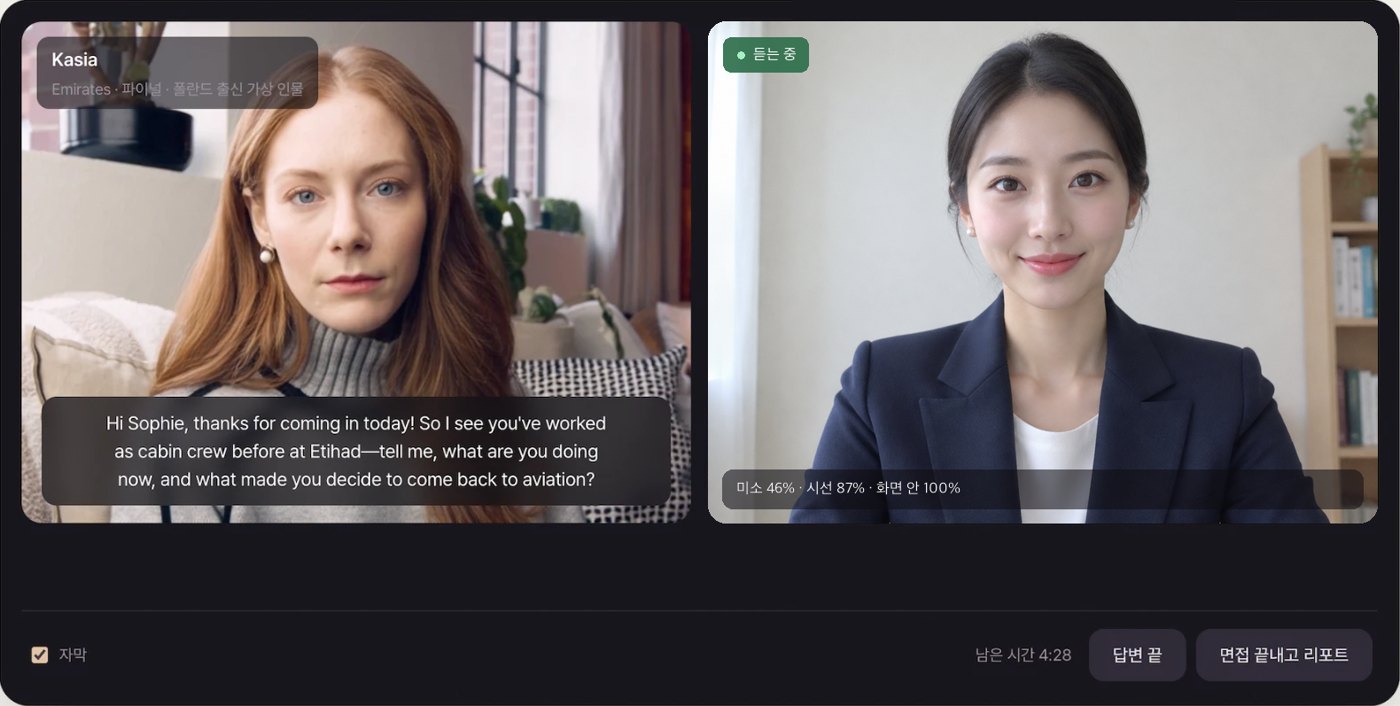
You meet the video interviewer in final interviews. They look at you while speaking, take notes while you answer and react with facial expressions that match their type. Other stages use the same interviewer's photo and a voice with a real accent.
Reading your report
Your report appears about 30 seconds after the interview. You can download it with the Save as PDF button.
- Verdict: how likely you are to pass this stage with the answers you gave, judged against criteria taken from real pass and fail reviews.
- The moments that decided it: the moments that most affected the verdict, with your own words quoted. Read this first.
- Speaking metrics: speaking speed (words per minute), filler words (um, uh), smiling, eye contact and how much of the time your face was in frame. Camera metrics are calculated in your browser, and the video is never sent to our server.
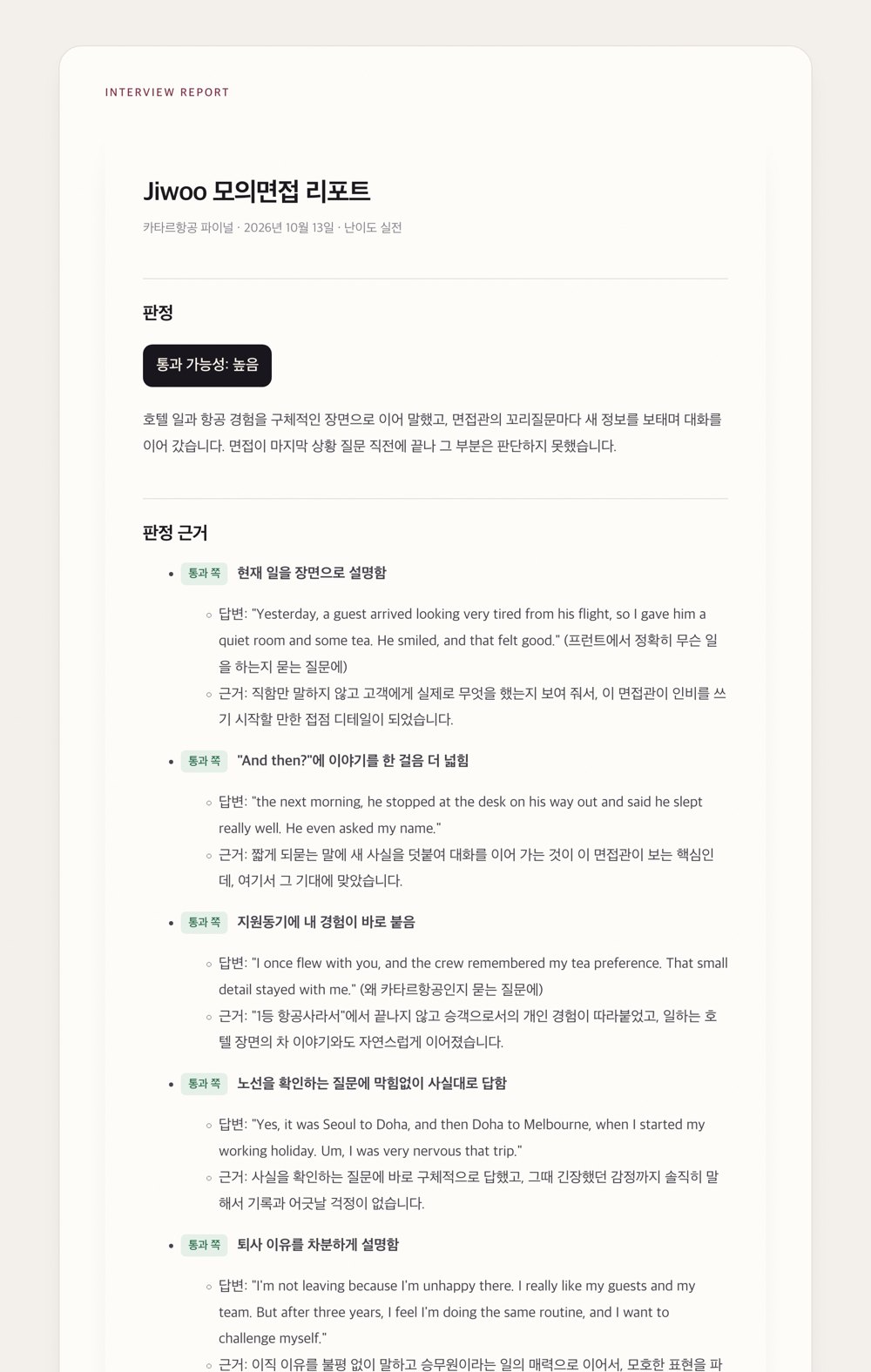
Don't try to fix everything in the report. Pick your single biggest weakness and check whether it's fixed in the next interview. You'll improve much faster.
Answer drilling
Answers you memorise by reading fade in the interview room. Answers you memorise by saying them stay. Answer drilling has you speak without looking at the script.
- Upload your script: upload your answers (pdf, docx, txt or hwpx) and they're split into one practice card per question. Your sentences are never changed. You can upload twice a month.
- Step 1, Listen: hear your answer read by a native speaker. This is the only step where you see the script.
- Step 2, Say it back: see only memory cues, not the script, and say each sentence. Missed words are marked straight away, until you can say the whole answer.
- Step 3, Answer alone: hear only the question and answer in your own words. We check that every key point is there, that you avoided phrases to leave out and that you finished in time.
- Step 4, Under fire: the interviewer digs in with follow-up questions. We check that you start answering quickly and that your facts match your original answer.
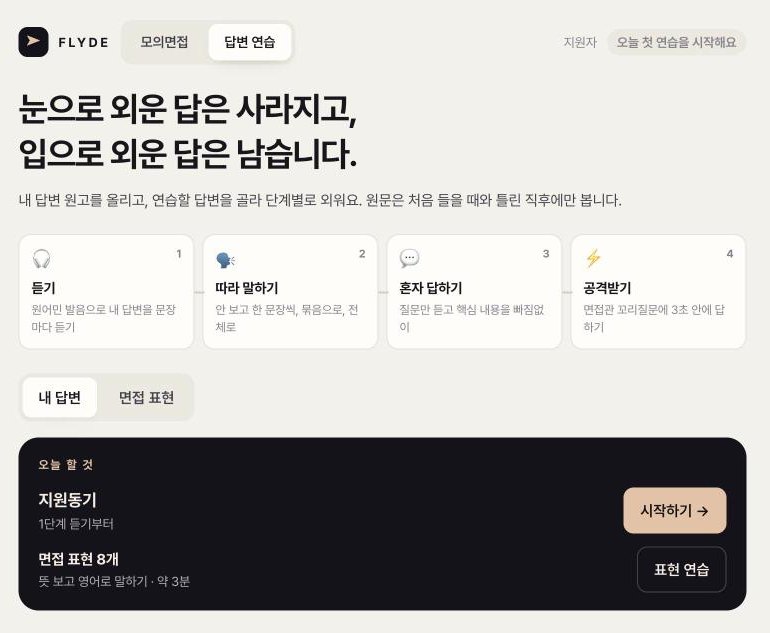
The Interview phrases tab has you say common English phrases from their meaning only: asking someone to repeat, first lines of an answer, onboard service and more.
A practice plan for your interview date
- Week 1: try each stage of your airline at Beginner to learn the flow. Upload your answers and start steps 1–2 of answer drilling.
- Week 2: move up to Real and do one video final a day. Fix your biggest weakness from the report in answer drilling.
- Week 3: use Challenge and random accents to build real interview instincts. Take answer drilling up to steps 3–4.
- Day 1: do every stage of your airline once at Real. Pick the stage with the lowest verdict.
- Every day: practise that stage first, then finish with 1–2 video finals.
- Take the questions that almost always come up (introduction, why this airline, experience questions) to step 3 of answer drilling.
- Focus on polishing the answers you have rather than writing new ones.
- Do 2–3 video finals a day at Real, and always read the report between them.
- On the day before, do just one light session and get to bed early. A good night's sleep consolidates everything you've practised.
- Start from the stage you failed, at Challenge.
- Choose a high-pressure or interrupting interviewer to recreate the situation where things went wrong.
- Collect "the moments that decided it" from several reports and you'll see the mistake you keep repeating. Focus on fixing that one.
- Start with answer drilling before mock interviews. Getting just your introduction and why-this-airline answers to step 3 changes the first five minutes of an interview.
- Learn phrases for asking someone to repeat and for buying time first. Simply not going silent when you miss a question changes how you come across.
- Start mock interviews at Beginner with a native accent.
Video interviews and the daily limit
The 30-day pass includes 30 video interviewer finals in total, and you can use up to 5 a day. Your remaining count is shown in the account label at the top of the mock interview screen. Voice interviews are unlimited.
Why is there a daily limit?
Because practice spread over several days stays with you far better than practice crammed into one day. Interview skill doesn't grow during the interview. It grows between interviews.
- Spaced practice lasts longer. The same amount of practice is remembered much longer when it's spread over days than when it's crammed into one. This is one of the most consistently confirmed findings in learning research, known as the spacing effect.
- Your brain sorts it out while you sleep. What you practise during the day moves into long-term memory while you sleep. That's why the answer you fixed yesterday comes out more naturally this morning. Five interviews and a night's sleep beat ten interviews in a row.
- Reading the report and fixing things is the real practice. If you only do interviews back to back, you repeat the same mistakes until they become habits. Read the report → pick your biggest weakness → fix the answer → drill it until it's natural → check it in the next interview. One full loop is one practice.
- Recalling after you've forgotten a little makes it stick. Repeating an answer you just said is easy but leaves little behind. Recalling an answer that has faded slightly overnight, without the script, is what makes it solid.
- Tired practice is poor practice. A video final is tense, like the real thing, and takes a lot of energy. Do too many in a row and your focus drops and you start reciting memorised lines mechanically. On the day, you need a lively face and voice from the very first question.
A good daily routine: 1–2 video finals → read the report and pick one weakness → drill the fixed answer → check it in a voice interview → get a good night's sleep.
Even when your interview is close and you need to cram, 5 a day is plenty. Once you've used them, carry on with report review, answer drilling and voice interviews.
FAQ
Can I use my phone?
Please use Chrome on a PC or laptop. Speech recognition and camera metrics work most reliably there.
When do the 30 days start?
Not on the day you pay, but on the day you first enter after buying. It's a one-time payment with no subscription.
What if I buy another pass while one is active?
The new pass starts when your current one ends, and it comes with a fresh 30 video interviews.
What happens when I've used all 30 video interviews?
You can keep practising final interviews with the voice interviewer. The questions, follow-ups and report are the same as with video.
The video interviewer didn't appear, but my count went down.
If the video connection fails, the video interview is automatically given back. If your remaining count looks unchanged, just start again.
Speech recognition doesn't catch what I say.
Use an earphone mic, find a quiet place and finish each sentence clearly. Two seconds of silence ends your answer, so when you need to think, buy time out loud with something like "Let me think for a second". That's a good habit in real interviews too.
Where do the questions come from?
From the question types and interview flow in real pass and fail reviews. The interviewer builds each question from your answers as you go. We never use leaked questions.
Can I use it on another computer?
Yes. Sign in with the same Google account and continue on any computer. One account can run one interview at a time, so starting an interview on another device ends the first one.
Are my face and voice stored?
Interviews with a pass are not recorded. Facial and eye contact metrics are calculated in your browser, and camera video is never sent to our server. See the privacy policy for details.
How often can I upload my answer script?
Twice a month. Uploading a revised script counts as one upload, so we recommend gathering several answers and uploading them together.
Do you guarantee a job offer?
No. FLYDE is an independent coaching service not affiliated with any airline. The simulator is a practice tool to get used to the real thing and find your weak spots.
Can I get a refund?
You get a full refund within 7 days of purchase if you haven't started an interview with the pass. Once you've started practising, the pass can't be refunded because the digital service has been used. Email [email protected] with your order number.
Why is there a daily limit on video interviews?
Because practice spread over several days stays with you far better than crammed practice. The full reasons are in Video interviews and the daily limit above.